Tuesday, March 27, 2012

Results from a reader

I received this note in the comments section and I thought I'd share it via a post. When I first started this blog, I'd hope that the information would be useful for others. I'm glad that this blog has been of use to at least one person. If anyone else has a similar story to share, please send it to me and I'll post it.

Hi KD,
I wanted to stop by and say thanks again for taking time to put this blog together and for answering my questions so quickly. I printed out the questions and brought them with me to my pre-op exam and that helped me get the answers I needed to feel comfortable with surgery.
I thought I would quickly share my experience for others that stop by. So far my experience has been similar to what you described for your wife. I had custom Lasik in both eyes, my prescription was -6.00 in both eyes with a very slight astigmatism in the right eye. Dr. Furlong said they would be removing about 75-80 microns. The Laser /ophthalmic tech named Will was awesome he answered a lot of my questions and quickly replied to my emails and also kept the mood light on surgery day which I really appreciated.
The Procedure:During the procedure everything happened pretty much as you described except my right eye didn’t go completely black when they applied the pressure it was more of a grey. Also to avoid the burning smell that people described I made sure to breathe through my mouth when I heard the clicking of the laser. This worked well. The only part of the surgery that was uncomfortable was the bright light that was on for a few seconds before the laser started.
After Surgery:After surgery my eyes were very light sensitive, they stung and kept tearing. I could barely open them for the drops. The numbing drops they proved helped but only lasted a few min. After using them 3 or 4 times I gave up and decided to try and sleep, which was hard to do. Having the windows covered help with the sleep and light sensitivity. My surgery was around 3:30 pm; I went straight home, straight to bed and tried to sleep as long as I could. After finally falling asleep I woke up around 9pm and my eyes felt much better. The stinging/tearing was gone, but still sensitive to light. I Ate some dinner and went back to sleep.
1 day postWoke up around 8am eyes felt drastically better. Sensitive to light, right eye felt scratchy and it was a bit hard to focus, but vision was clear and functional. At the post op exam they said I was seeing 20/20 but I still saw halo and rainbows around bright lights. I didn’t feel ready to drive but I was able to watch TV look at my phone and go out for dinner but required lots of eye resting in between.
Today is 4 days post-lasik and I’m back at work, I’m still using antibiotics and steroid drops every 4 hours and sleeping with eye shields (which I thought would be uncomfortable but really aren’t bad). Right eye has felt scratchy ever since surgery, haven’t had much trouble with dry eyes but it’s a bit worse today being in the air conditioning at work. Left eye feels normal and I’m using the lubricating drops every hour as directed. I drove a little bit today but its gloomy/raining out so people have their headlight on which means halos and rainbows for my eye which are still a bit light sensitive. Hopefully this gets better as my eyes heal.
Two other things I would mention are my eyes tend to lose focus often and I have the strange urge to take out my contacts.
Thanks Again and Congrats!!!
Congrats! 


For having a prescription of -6 with astigmatism and the fact that you are seeing 20/20 the day after, I would declare that a resounding success! I think you stand a good chance of hitting 20/15 by the 6 week check up. If you do, please let me know so I can post your results.


Your experience is a little different as you are seeing rainbows. My wife did not experience the rainbow effect, however she had the exact same light sensitivity. By the way, the contact in the eye feeling and the feeling of scratchy eye is basically symptoms of dry eye. So yes, you are experiencing dry eye symptoms. I hope it clears for you soon as that is the worst symptom of all post LASIK. I should mention that there is a difference between dry eye symptom which everyone gets immediately post LASIK surgery and chronic dry eyes which is what you don't want to get. If the symptom persist...ugh.


I've got good news for you though, my wife's halos has just about gone completely away. I think you can at least look forward to the halos decreasing as well. My wife can read the default font on the new Retina IPAD  from reading distance so I hope to see 20/15 for her result this week. If not, then we can chalk her up to being one of the unlucky ones who can only achieve 20/20. =)

Sunday, February 19, 2012

6 Week Post Op

The wife is almost at 20/20. She still misses the D's and the O's. On the bright side, she can make out a few of the letters on the 20/15 line as well. However, those letters are a little blurry still. She still has halos but it's not that bad. She has stopped using the artificial tears awhile back because she just doesn't feel the need. The doctor recommends that she keep using. She said she would but somehow I doubt it very much. It's human nature. She's basically living like a normal person with good vision without being tethered to the glasses, contacts, or tear drops.

I'm actually disappointed that she hasn't hit hit her 20/20 benchmark yet. Then again, conventional wisdom say that it may take up to a year for recovery. Is almost 20/20 at 6 weeks with a -5.25 prescription good or bad? Who knows. Plus everyone heal at a different rate. We'll just have to wait for the 3 month post-op to find out.

I may be disappointed, but she's ecstatic. Being able to see the clock at night and not having to shuffle for glasses is liberating for her. Plus, not having to deal with contacts, losing a contact, and then having one stuck in the eye (which happens regularly for some reason) is another plus. Yes, she would definitely have this procedure again.

We have another surprise: she's pregnant. Of course, most LASIK doctors don't recommend getting pregnant for at least 6 months after LASIK. There goes conventional wisdom.

Friday, February 3, 2012

3 Week Post Op Vision Quality

Remember, every individual is different. Just because your experience is different does not mean that there is a problem. Also, don't expect to have the same results because there are so many different factors including pre-op vision, perscription, existing higher order aberration and existing conditions such as dry eye symptoms, etc.

My wife had -5.25 pre-operative prescription. That means that about 80 microns of her cornea was removed. That is not a small number. It's like a minor wound versus a large wound. The minor wound would heal much faster. Most people who have had flawless vision the day after probably had low myopia to begin with. A test of how well the LASIK technology work is not to ask someone who had -1.25 prescription pre op but ask someone who had medium to high myopia. Many of the ecstatic reviews for LASIK by patients who claim they can watch TV in 4 hours and drive immediately the next day are probably from patients with low myopia. Low myopes will have exceptional results with any system even the 10 year old standard NIDEK laser. That's just the way it is.

Sift through the results and compare apple to apple. For patients with high myopia and astigmatism, exceptional results may be rare. However, if you have a low prescription, you should expect to drive the next day with low complications. Temper your expectations based on your individual characteristics.

LASIK is surgery and all surgery requires healing. For my wife, she was able to see the next day and her vision was hovering between 20/25 and 20/20 the day after. That is an outstanding result! However, the halos around light sources were pretty bad. She was not able to drive the first week because the halos were blinding. I am happy to report that she has been driving at night now with no problem. The halos are still there but they are not that bad. Other than the first few days, the halos are not disruptive or blinding.

Most doctors would tell you to expect up to a year for most post-op LASIK complications to go away. My wife is satisfied with the halos right now even if it never goes away. She would gladly trade her practical blindness for a little halo. However, with the vast improvement in the symptom with the halos from the first few days to now, I hope (and expect) that it will totally go away by 3-6 months.

The biggest issue any LASIK patient should worry about is dry eyes. I have minor starbursting naturally occurring in my eyes at night (I never even realized that this is not normal until I researched LASIK). It doesn't bother me. Just like the minor halos is not bothering my wife. However, the one thing that did bother her was the initial dry eye symptoms and the contact in the eye feeling. Luckily for her it quickly went away . She only used one tear drop the last three days, usually when her eyes get tired from reading the computer screen or her files.

My cousin had dry eye symptoms for an entire year. It "sucked" was his words. He had to constantly use the natural tear drops many times a day. My wife did not have dry eye symptoms pre surgery so it didn't bother her post-op either. However, if anyone has existing dry eye symptoms, that person should consider it as it's most likely will get worse.

My wife believes that her color/contrast and close up reading is superior now 3 weeks post-op as compared to pre-opt. You have to realize that her best corrected visual acuity was not that good to begin with. I have a feeling that it was due to her existing higher order aberrations. On the freeway, she previously was able to read signs at half the distance that I was able to even with her contacts. I was able to read signs a few seconds before she can make it out going 60 mile per hour. Her contacts corrected her vision up to a point, but beyond that distance her clarity just collapsed. Now, even with her eyes still healing, she is able to read signs much farther away. As you can see, she's very happy with her results at 3 weeks. She was able to see before with contacts, but she is able to SEE now without it. The quality difference is there, even with the nighttime halos.

Random Musing
So why do LASIK patients post op have starbursting and halos? The reason is most likely due to higher order aberrations. As I discussed previous posts, all LASIK procedures tend to induce higher order aberrations. Even people with normal vision has it (I do) and contacts or glasses cannot fix HOA. Even the machines that claim to be neutral (optimized) or corrects it (guided) tend to induce HOA. The fact that her halo issue is diminishing tells me that it is not due to her pupil size at night but due to the higher order aberrations which tend to be highest immediately after surgery. This is the reason why patients with existing high HOA should select a technology that attempts to fix it. That doesn't always mean that it can fix it (or in most cases limit it), but the studies have shown that patients with high HOA tend to have better results post-op with wavefront-guided technology. Optimized technology attempts to avoid creating new HOA but that doesn't mean much--all LASIK procedures tend to create HOA! Here is another study comparing HOA and the technologies. Notice that with the VISEK, 1/3 of patients had reduced HOA while 1/3 had worse even with the attempt to correct HOA. However, with the optimized version 60% of the post-op patients had worse HOA post-op with only 15% having improved HOA. If it can't get better, it should stay the same, not worse! Higher Order Aberration is a hugely important factor that should be a consideration for all patients with high myopia.


http://en.wikipedia.org/wiki/LASIK#Higher-order_aberrations
http://www.eyeworld.org/ewsupplementarticle.php?id=252

Tuesday, January 31, 2012

Yelp!

I use Yelp on a regular basis. I like it so much that I contribute on a regular basis. However, recently, I realized that Yelp can be paid and bought. If you advertise with them, you can bury reviews that may be...mildly critical of the establishments.

Yelp claims they run reviews through anti-fraud filter. Basically, it tries to detect fake reviews and filter them out.

Guess what? Dr. Bindi recently has a prominent Yelp banner on his website. This means that he paid the company for the advertisement. What does this do for him? It pushes 5 star reviews high up and then...bury reviews that may not be exactly glowing. That's fine, they have to earn money somehow.

Interestingly enough, my review got filtered out. Yelp can push unfavorable reviews down, but when they filter out legitimate reviews as bogus, then they stepped into the the realm of shadiness. Now, I ask you, with my active review writing and even with my taking out some of the sharp criticisms, the review still got filtered out. Why? Because I spoke the truth. Unfavorable 3 line reviews are OK, but a balanced and truthful review backed up with research will get filtered out. Nevertheless, my review for Dr. Furlong stays. Am I bogus or not, Yelp? You can't have it both ways.

Did Dr. Bindi after having paid Yelp to promote him requested my review be buried? You decide.

That is so wrong, Yelp. Apparently, you can buy reviews on Yelp or pay to filter unfavorable reviews. This may not be Dr. Bindi's fault, but it may come back to hurt him in the long run. Most Yelp users click on the filtered reviews to get the whole picture sans shady dealings. Having a legitimate review buried is bad for business.


Update 3/22/12: Okay, it looks like it's part of Yelp's funky algorithm. It wasn't part of some diabolical conspiracy by Yelp and Dr. Bindi.  The trick is to add some friends and update your profile with your real name and it will eventually get your review out of filter.

Friday, January 27, 2012

1 Week Update

I guess I totally forgot about this blog. Her one week check-up shows that one eye is 20/20 the other is close to 20/20. Now that it's three weeks later, I have no doubt that she can see 20/20 in both eyes. We used the eye chart app for the IPAD and she can easily read the 9th line on it. She can make out only some letters on the 10th line (the 20/15 line).

The day after surgery, every light source had extreme halos. She is seeing some halos still with her eyes which were not there before. However, the halos had lessen more and more every day. The halos if most likely the reason why she's not able to read the 10th line. She can make out obvious letters but certain curved ones still glow too much.

Her dry eye is extremely minimal. She would have to remind herself to use the artificial tear because she often forgets. Her one month check up is coming up. We're still holding out for 20/15 once the halos go away. That could be up to three months away.

Why are we shooting for 20/15? The reason is 20/20 is only average human vision and not "perfect" which is a misconception most people have. 20/15 is very good. True perfect human vision is probably 20/12-20/10. It's very rare to have vision anywhere close to 20/10 but 20/15 is the gold standard for "perfect" human vision.

http://itunes.apple.com/us/app/eye-chart-pro/id364802332?mt=8
http://en.wikipedia.org/wiki/Visual_acuity

Wednesday, January 11, 2012

Lasik Complications

Isn't it odd that I'm posting about LASIK complications after the procedure was completed? Previously, my wife was so gung-ho about LASIK that she didn't want to wait (or cared) about the potential complications. Luckily for her, I actually cared and did all the research for her. Now that the procedure has been a success, I'm not sure what to do with those notes. I might as well share it here.

The first thing you need to know is that not everyone is qualified for LASIK (or PRK). This is where having a qualified and scrupulous doctor is very important, beyond just selecting the correct technology for your prescription. Ten years ago, there was a money grab with some doctors who was not always looking out for the patient's benefit. Even now, there are still cases of people who angry and upset about their quality of vision after LASIK or felt they were mislead by their doctors. Being able to see without glasses is great, but having star-bursts, halos, and dry eyes could be debilitating.


Therefore, it's not surprising that you are now required to sign the informed consent forms that state all the potential LASIK complications. The problem with the consent form is that it doesn't tell you what, why, or if you are in a higher category of danger for having those complications. It just states that there are complications as a result of LASIK. This is why it's important that you educate yourself first so that you can can ask the proper questions to the doctor and see for yourself and understand why and if you are a good candidate rather than just relying on the doctor's yay or nay diagnosis. Only you can decide if the risks are worth it. Unfortunately, certain individuals are in a higher risk category.

Pupil Size
If you research LASIK complications on the Internet, the vast majority them are due to the doctors not informing their patients that they have larger than normal pupil and pushing them unadvised LASIK procedures. Did you watch the 20/20 special on LASIK regarding double vision, halos and star-bursts? Doctors should turn away prospective patients if they have higher than normal pupil size. The average ablation zone for the laser is 6.5mm. The average pupil size is around 6mm. If your pupil expands at night beyond the ablation zone, that's when trouble starts. Problems such as star-bursts, halos, etc occur due to to the correction zone being smaller than the size of the expanded pupil. This is why most LASIK issues with halos and star-bursts occur at night when the pupil expands. Read this to understand more about problems with large pupils. Most modern wavefront laser attempt to fix potential night time vision issues by creating a bigger blend zone. This may help in some cases but there is no concrete proof that blend zone resolve the problem of having large pupil size! In general, if you have larger than average or larger than the laser's ablation zone pupil size, the doctor should turn you away. If the doctor doesn't, your spidey senses should tingle!

Higher Order Aberrations
Large pupils are not always the cause of problems, higher order aberrations can also be the cause of these problems. In an earlier posts, I mentioned that LASIK (and PRK) procedures tend to create higher order aberrations. Wavefront-optimized attempt to limit that whereas wavefront-guided attempts to correct it. Your objective is always to limit higher order aberrations, especially if you already have higher order aberrations, however all LASIK laser and procedures as a by-product create some sort of higher order aberrations.

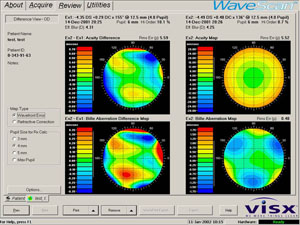
Therefore it's important to have a wavescan performed to measure the existence and magnitude of it. My wife who had problems with higher order aberrations was never able to achieve great vision pre-op even with her contacts. I have 20/15 vision, but at night I see slight starbursts that is very slight, nothing as bad as the picture shown above. Even with my naturally excellent eye sight, I'm pretty positive that the existing higher order aberrations in my eyes are the culprits for the slight starbursts at night.

This is why some pay more and some pay less for their LASIK procedure. In my opinion, it's ridiculous that some surgeons even offer these as a choice for prospective patients unless they have a very slight prescription, even then I would be wary of not opting for the wavefront solution. Standard LASIK doesn't offer blending zone which is is why some patients in the past who had standard LASIK with average pupil size still ended up with problems of starbursts and halos. If these patients knew ahead of time that the cheaper standard LASIK laser may deliver substandard results for medium to high myopes as well as having a tendency to cause more higher order aberrations, would they choose it or opt for the more expensive option?

Dry Eyes
This is the other biggie. Most doctors today will ask you if you have existing dry eye symptoms. If you already have dry eyes, LASIK may further cause issues and you should reconsider. My cousin who did not have dry eyes pre-op had pretty bad symptoms for close to a year. My wife on the other hand had it for for the first couple days on only one eye. Five days later she is only using artificial tears every four hours or so. You never know. Chronic dry eyes could be a very bad problem. Discuss this fully with your doctor if you have existing dry eyes or the potential of having dry eyes.

Thin Corneas
If you have thin corneas, don't be surprised if the doctor recommend only PRK for you. Early on, some doctors performed LASIK on patients without checking their cornea thickness or pushing the boundary of safety. The result for some were ecstasia due to excessively thin corneas...and of course malpractice suits for the doctors. This is why if you have thin corneas, your doctor will tell you that you are only qualified for LASIK but instead offer PRK. Did you know that there are now advancements in PRK such as LASEK and epi-LASEK where the recovery time is much faster than PRK? So far, I haven't seen any south bay doctors offering this version of PRK. If faster recovery time is desirable, you may want to look for a doctor who offers LASEK.

Hacks
What is a hack? That's an unqualified doctor or one who cut corners in order to save money. It can be anything from reusing microkeretome blades to pushing people to perform LASIK when they are clearly unqualified. If you are on an assembly line, with 20 patients waiting for LASIK from morning until late into the night, the doctor obviously wants to get through each of you quickly. If something as delicate as surgery is hurried, mistakes may occur either through carelessness or tiredness. For example, this one individual waited until 10PM because the clinic overbooked. Not surprisingly, she ended up with problems. Here is this one person who had his vision ruined because the 'doctor' (who knows, this is Peru after all!) didn't calibrate their machine properly. Or then there are cases of people who had LASIK done too soon while their vision was still regressing. So be very careful if the doctor offer the LASIK at an extremely cheap price, you are not able to ask questions with your doctor, you are pushed to have a procedure, you see are waiting 3-4 hours for a consultation, or you show up to your surgery but end up sitting on the floor with the waiting area looking like a refugee camp.

Are you scared yet? Well, if LASIK was that dangerous, I wouldn't have let my wife go through with it. There has been 31 million LASIK procedures performed. The number of satisfied patients outnumber the unsatisfied patients by many factor. Also, many of the complications were a result of doctors pushing unqualified individuals to have LASIK done when they were clearly not candidates for it. Nevertheless, you should still prepare yourself for the possibilities of complications. The doctors we consulted with are all well respected and are careful to screen their candidates. They have their reputation to protect and have been in business a long time for a reason. However, based on the horror stories out there, not all doctors are that conscionable.


The majority of LASIK complications I've read online are due to (a) large pupils, (b) dry eyes, or (c) thin corneas. There are a small percentage with complications that are unrelated to the above three such as flap complications and misdiagnosis of prescription or miscalibration. It is an elective surgery and there are risks involved. Educate yourself before you go for a consultation. Question everything and do not take their answer as gospel. They may be medical doctors but they are also human. Greed sometimes cloud people's decisions.

LASIK is a miracle cure if everything goes right. As with anything involved with the human body, when things go wrong it could go very wrong. So think twice next time you go to Tijuana for the $800 LASIK. It's a decision that will affect you for better or worse for the rest of your life.

Disclaimer: This is my opinion. This should not be considered medical advice.

References:
http://www.realself.com/review/king-of-prussia-lasik-put-disability
http://www.usaeyes.org/lasik/faq/lasik-pupil-size.htm
http://www.allaboutvision.com/conditions/aberrations.htm
http://lasik-flap.com/forum/viewtopic.php?t=850
http://www.realself.com/review/new-york-terrible-pain-sleep-lasik-laser-vision-correction-surgery
http://www.allaboutvision.com/visionsurgery/lasek.htm
http://www.allaboutvision.com/visionsurgery/epi-lasik.htm
http://www.realself.com/review/lasik-brazil
http://www.realself.com/review/lasik-waist-money-canada
http://www.realself.com/review/only-last-few-years
http://www.realself.com/review/lasik-great-dont-do-it-too-young

Friday, January 6, 2012

The Procedure

The entire procedure lasted maybe 15-20 minutes including the prep time. The actual Intralase process completed in 15 seconds per eye. The Excimer laser lasted maybe 30 seconds per eye. In between, the surgeon and three support staff helped did their job. It was fascinating to watch the procedure on the television set.

The scariest part of the procedure and probably the most difficult portion of the procedure for my wife was the cutting of the flap. I think it was mostly psychological. By taking the oscillating blade out of the equation, the biggest fear was also removed. She opted to skip the Valium altogether. It wasn't necessary because to her the laser wasn't as scary as the microkeretome, which is a glorified oscillating razor blade. The anticipation of the surgery was the hardest part for her. The actual surgery was over before she knew it.

The Prep
For the surgery prep, her eye areas were wiped with antibacterial wipes. She donned the the surgical cap to keep her hair out of the way. Afterward they brought her into the surgical room where the Intralase FS and Visx S4 IR machines dominate the room. The room has a glass window to allow family members to view the procedure. There is a television that displays the camerea from the laser's and surgeon's point of view.

Before the doctor came in, the assistant adjusted the laser level so that so that it was level with my wife's head. She told me that the scene from Final Destination 5 kept popping into her head. Bad idea to watch that movie before the surgery. Fortunately for her, that movie made absolutely no sense. Let's see how many things that it got wrong. First of all, she was never left alone. There was always at least two person in the room with her. The laser does not work on autopilot, so it must always be operated by the surgeon. A rogue killer laser was just not possible. The laser has a fail-safe that shuts itself down in case of a malfunction. Furthermore, the laser beam is ultraviolet which is invisible. Heat would cook the surrounding cells. The reason excimer laser works so well is due to its ability for pin-point accuracy without burning the surrounding cells.

The Procedure
When the doctor finally came in, the surgery was ready to begin. My wife was positioned under the Intralaser laser and had the eye clamp positioned to keep the lids from closing. Yes, at least the director of Final Destination got that one right. Multiple numbing drops were applied to numb the eyes. Then they checked her corneal thickness again with an ultrasound device. Finally, they asked the patient her name and birth date. I assume this was to prevent accidental procedure of the "custom" procedure on the wrong patient.

The doctor asked her to look at his forehead in order to position the eye. The suction cup was laid over her right eye. On the TV, it looked like the eyeball got flattened by the suction device. What she saw under the suction cup was a series of white light. She didn't know or felt the Intralase laser cut the flap. On television, I saw the outline of the flap appearing by the changes in a lighter shade of her cornea as the laser cut the outline of the flap. Once the flap was finished, the doctor applied something like tape to keep it closed and then then the process was repeated for the second eye.

Once the second flap was cut, the doctor moved her over to the second machine to start the actual fixing of her vision. He used a surgical device to separate the flap. This piece looked kind of like a dentist's pick as he because it has a needle end to gently separate the flap. When the flap was moved, her vision became blurred and everything became 'bouncy'. That's her description, it was as if her vision was moving. The doctor asked my wife to look at the red light. On the TV, it looked like a circular red target. Imagine the point of view of the Terminator as he's looking at his target with the bracketed heads up display. That's what the red target looked like. When the laser started, there was a zapping noise that sounded like firecrackers going off. It was fairly loud. She told me that her entire vision blacked out at that point. My wife thought they turned out the lights. Except they didn't. Good thing she didn't know what was happening. It was probably more comforting to think that the lights were turned out than knowing that at that moment your eye just shut itself off by the blinding ultraviolet light. She said it smelled like hair burning when the machine was zapping her eyes. The corneal tissues that were responsible for her bad vision were going to a better place, vaporized into nothingness.

Once the process finished, the doctor scrubbed the cornea with a surgical tool with flat side. He reapplied the flap then pushed it down with another tool that was circular in nature. Then he applied a bunch of medicinal drops on her, perhaps antibiotics, steroid and numbing drops. She said once the flap was reapplied she could immediately see clearly albeit with a slight haze. One thing was for sure, it was much better than the pre-op vision. The same procedure was performed on the second eye. After everything was done she just got up and walked to the next room for the post-op consultation where they gave you the shades, the surgical eye cover for the first few nights of sleeping and the schedule of medicine application.

That was it. We arrived around 12:25. The procedure started at 1:05 PM. We left the building at 1:30 PM.

The First Night
Other than some dry eye symptoms on her left eye, everything appeared normal. Her right eye amazingly has no issue, no pain or dry eye. Only her left eye has dry eye symptoms. It was also the eye that required numbing drops the first night due due to the contact in the eye feeling. She describes it as feeling as if something was left in the eye. We were told that this was normal due to dry eye symptom from the LASIK procedure. She's actually lucky as her symptoms are very minor. I guess this is why LASIK is the preferred procedure over PRK. It's almost close to zero recovery time.

The Next Check Up
Her eyes were tested the next as 20/20 and 20/25. The left eye that was bothering her with dry eye is weaker than the right. Her vision is clear other than the haze that covers it. She describes it as kind of like looking through a foggy filter. The interesting thing is that other than the haze, she swears she can see better than she did with her contacts. Her vision is just sharper. I wonder if this was due to her higher order aberrations? Before the surgery, she had poor quality vision even when she wore glasses or contacts. Her distant vision was only half as good as mine. However, one day after surgery, her vision is of better quality than she ever had even with contacts! It's truly remarkable technology and nothing short of miraculous.

We're looking forward to the one week consultation. Hopefully once the swelling and haze go away, her vision  will  improve even more. She's extremely happy with her decision to have LASIK done. I asked if she had to do it again, would she go through with it? She says yes she would do it again in a heart-beat and that you can't put a price tag on her improved quality of life. Well, there you go. Another LASIK evangelist is born.